Medical Illustration & Animation #39: Interview with Cover Artist, Violet Frances
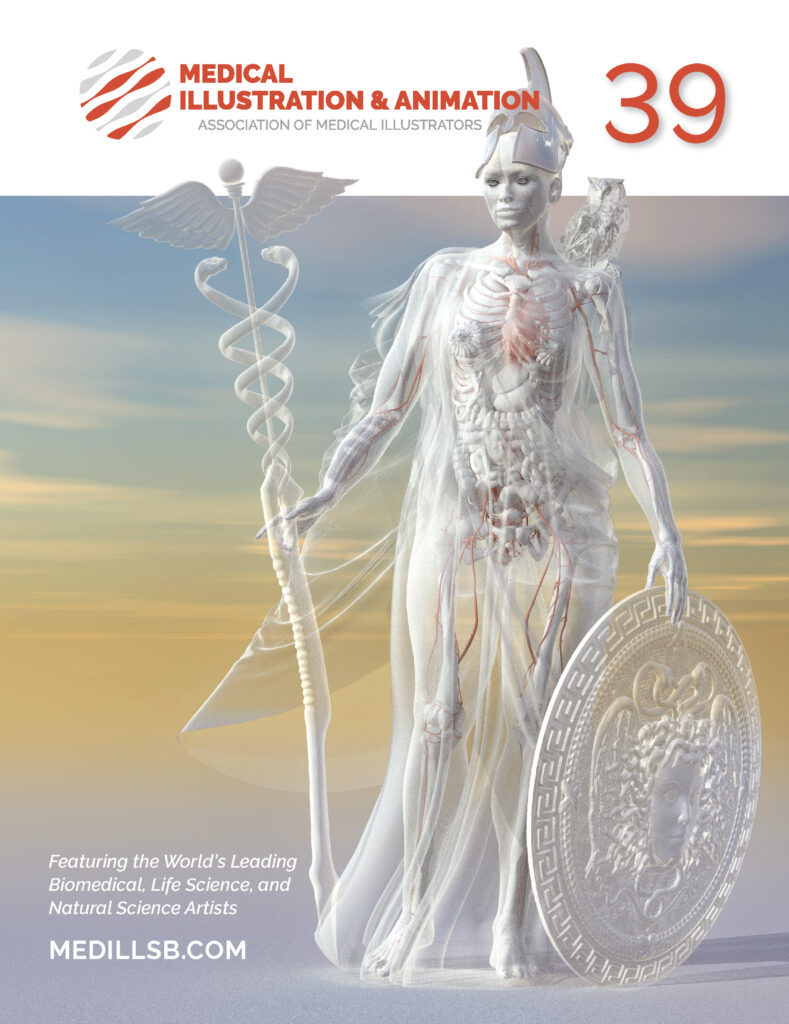
When you look at the cover of the 39th edition of the Medical Illustration & Animation Sourcebook, you are looking at much more than a masterclass in digital precision. You are witnessing an alchemy of classical art history, high-concept visual journalism, and a deeply felt reverence for human biology.
The artwork—featuring a striking, translucent depiction of Athena accompanied by an owl perched on her shoulder—was created by award-winning artist and animator Violet Frances. With a career spanning three decades, Violet’s path has crossed jazz stages in New York City, the art department of Scientific American, and international acclaim for her revolutionary approach to 3D anatomical rendering. After gracing the cover numerous times in the past, Violet has returned to the sourcebook with a cover illustration that feels both historically grounded and thrillingly futuristic.
We sat down with Violet to discuss her creative philosophy, the Renaissance masters who changed her perspective on digital tools, and the profound symbolism behind this year’s AMI 39 cover.
On the Connection Between Jazz, Abstract Physics, and Visual Problem-Solving
Your background spans some incredibly distinct creative worlds, from jazz music to publication design at Scientific American magazine. Do you feel that your early discipline in music or your time translating abstract, “impossible to illustrate” physics concepts shaped the way you approach visual problem-solving today?
Violet: Absolutely. I would not be the artist and illustrator/animator I am without my musical training. It helped establish my work ethic, and it gave me a deep respect for order and harmony and all the effort that is needed to get good at something — and how, within that harmony, discord can be played with in a beautiful way. It also gave me an appreciation for the inner workings of things.
Music is abstraction, yet it evokes very real, nameable, concrete feelings and states. The same is true for illustration. A drawing is a collection of abstract lines that come together to form an understandable image. Working at Scientific American helped me discover the beauty of scientific illustration. I fell in love with the simplicity of Feynman diagrams and was struck by how these abstract marks I didn’t quite understand could contain worlds of meaning. I believe they looked beautiful to me because they held so much meaning.
When I’m at my best as an artist, I’m bringing a near-childlike sense of wonder about the world coupled with my decades of experience as a visual journalist. When I’m in that space, solutions reveal themselves in unexpected ways and manners.
Finding Humanity in the “Cold” World of 3D
You’ve spoken about finding a profound sense of spirit in High Renaissance art. How did studying the masters change how you approached the often “cold” digital tools of 3D illustration, and how did you navigate blending those two worlds?
Violet: When I left Sci Am in the late 1990s to begin my freelance career as an illustrator and animator, the only work I could get was in the medium of 3D illustration. Problem was, I didn’t like working in 3D. It struck me as hard, flashy, cold-looking. Creating human figures in 3D was beyond hopeless back then. Everything turned out robotlike and lifeless. And for a while I thought that was just the deal with the 3D medium.
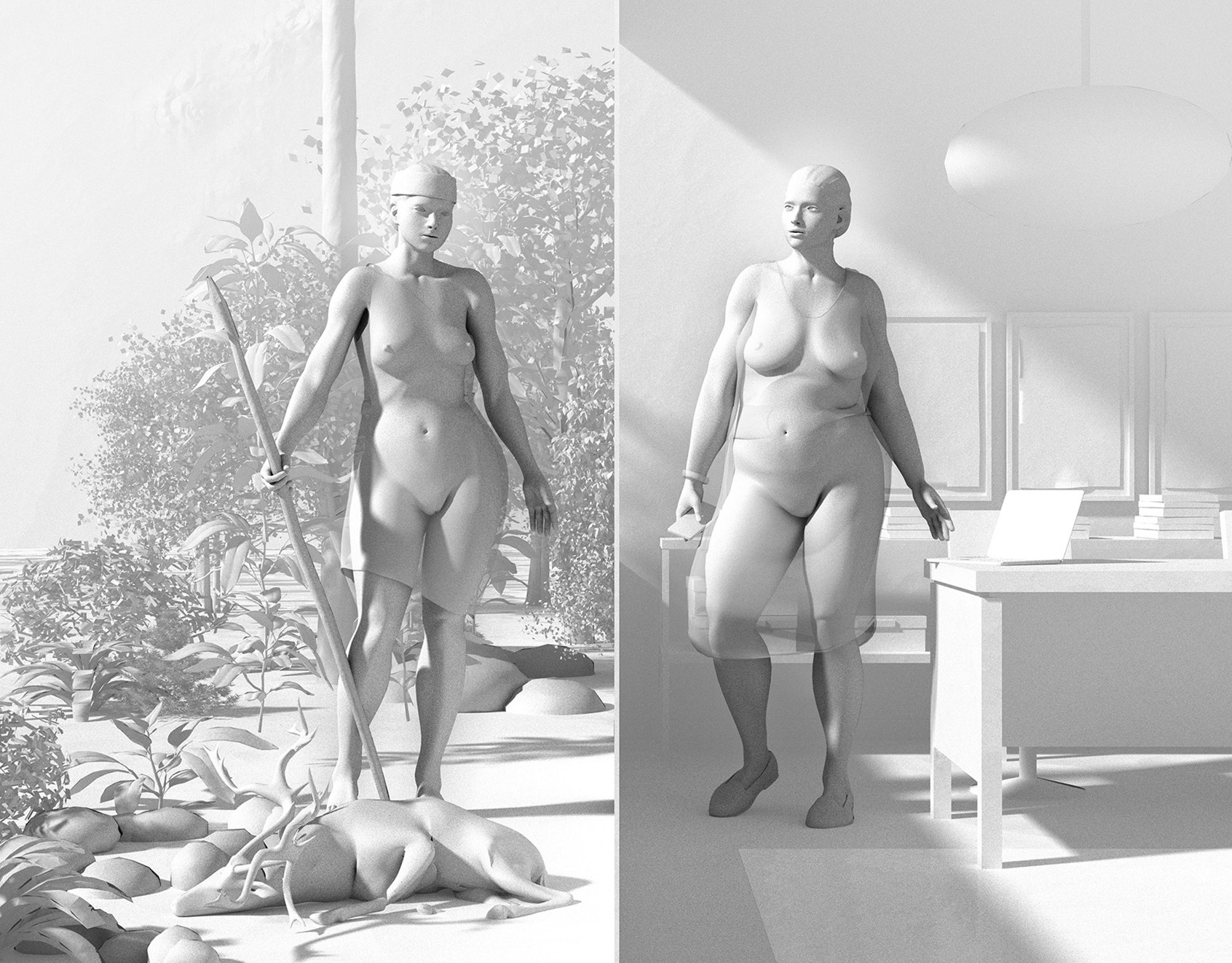
But something clicked a few years later, when, on a visit to Rome, I witnessed Michelangelo’s Pietà at the Vatican. I was thunderstruck. Here I was, looking at a hunk of marble that was sculpted as flesh, and that flesh hummed with so much spirit and emotion. Marble. As in stone. I thought, if such exquisite feeling could be expressed in as unwieldy a medium as marble, then why not in 3D?
I realized I had been purely focused on the anatomy and not the humanity, but humans are manifestations of the emotional and spiritual. Michelangelo captured that, so that’s when I started really thinking about how bodies occupy space. We don’t walk around robotlike, ramrod straight — we sit, we slouch. I thought about how humans are the audience for these illustrations, so if I put some life into these figures, there would be more ways for them to connect with the material.
The Symbolism of Athena, the Owl, and Interconnectedness
Turning to your gorgeous cover art for AMI 39, the imagery features a striking depiction of Athena with an owl on her shoulder. What drew you to Athena as a symbol for this year’s book, and what does the owl represent to you in the context of natural science?
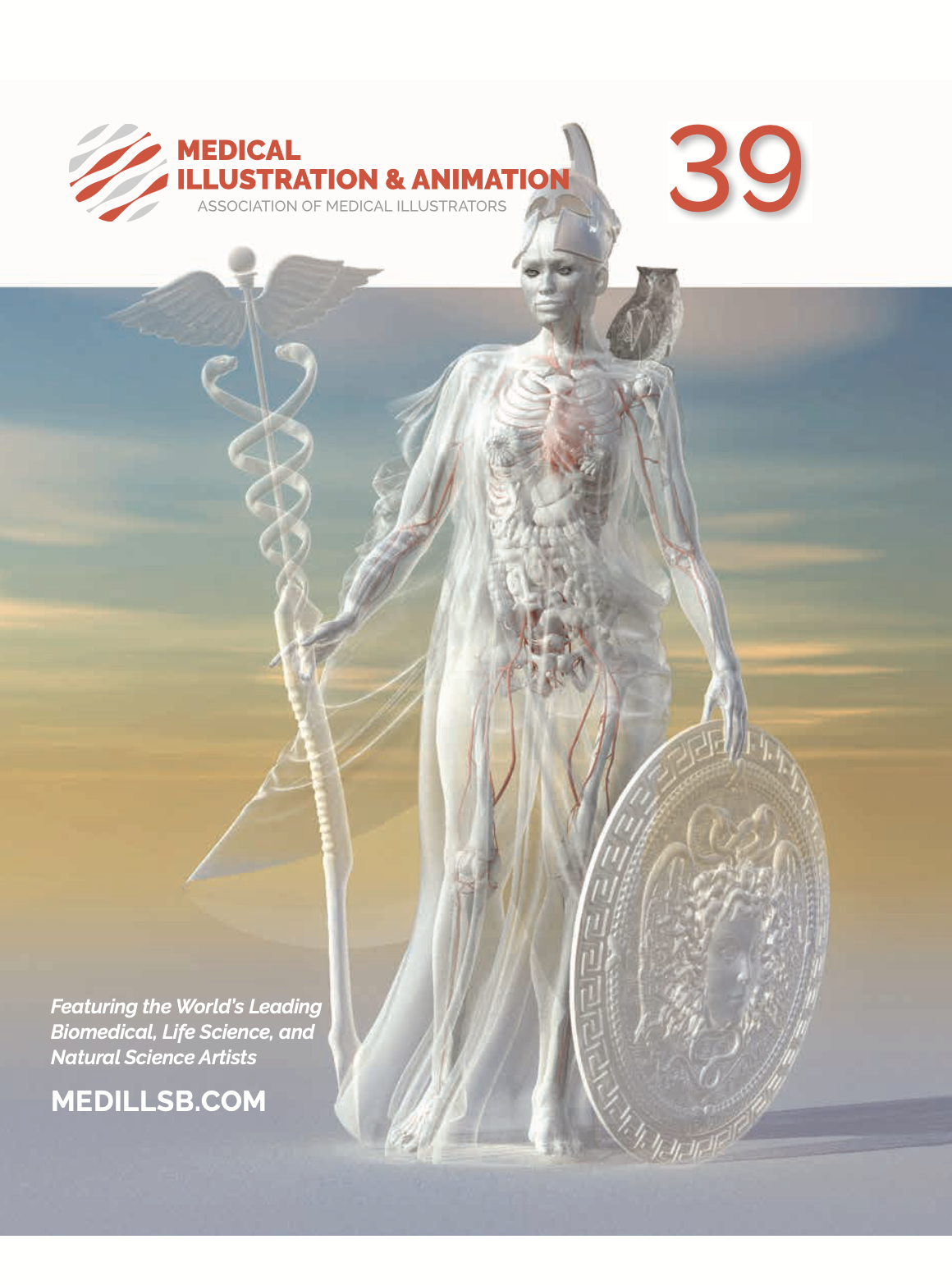
Violet: With science, reason, truth, and empathy under attack these days, Athena — who in mythology is a protector of Athens and knowledge — is a potent symbol. I used the owl, which is associated with Athena, in this illustration as a subtle nod to how we as humans are not the only thing on this earth, that we are interconnected. When I look at a human skeleton and an owl skeleton, I see more similarities than differences. The owl is a reminder that we are interdependent, that our interconnectedness is what has kept us alive evolutionarily. There are no owls on Mars.
Something that I feel is quite lost in this technologically rabid environment we’re currently learning to live in is that we are animals. Yes, there are incredible advancements, we have sophisticated language and opposable thumbs, but we are just animals. And what we need and desire, what drives us, is intrinsically linked to our biology, not our technology.
“My work often reads as futuristic or sci-fi, because I’m letting the medium speak for itself.”
Bridging Historical Artistry with Future-Facing Mediums
The cover manages to feel deeply historical yet distinctly futuristic at the same time. How do you balance referencing historical artistic techniques while pushing forward into modern medical illustration and animation?
“If 3D is just a new material to make marks with, how would Matisse have used it?”
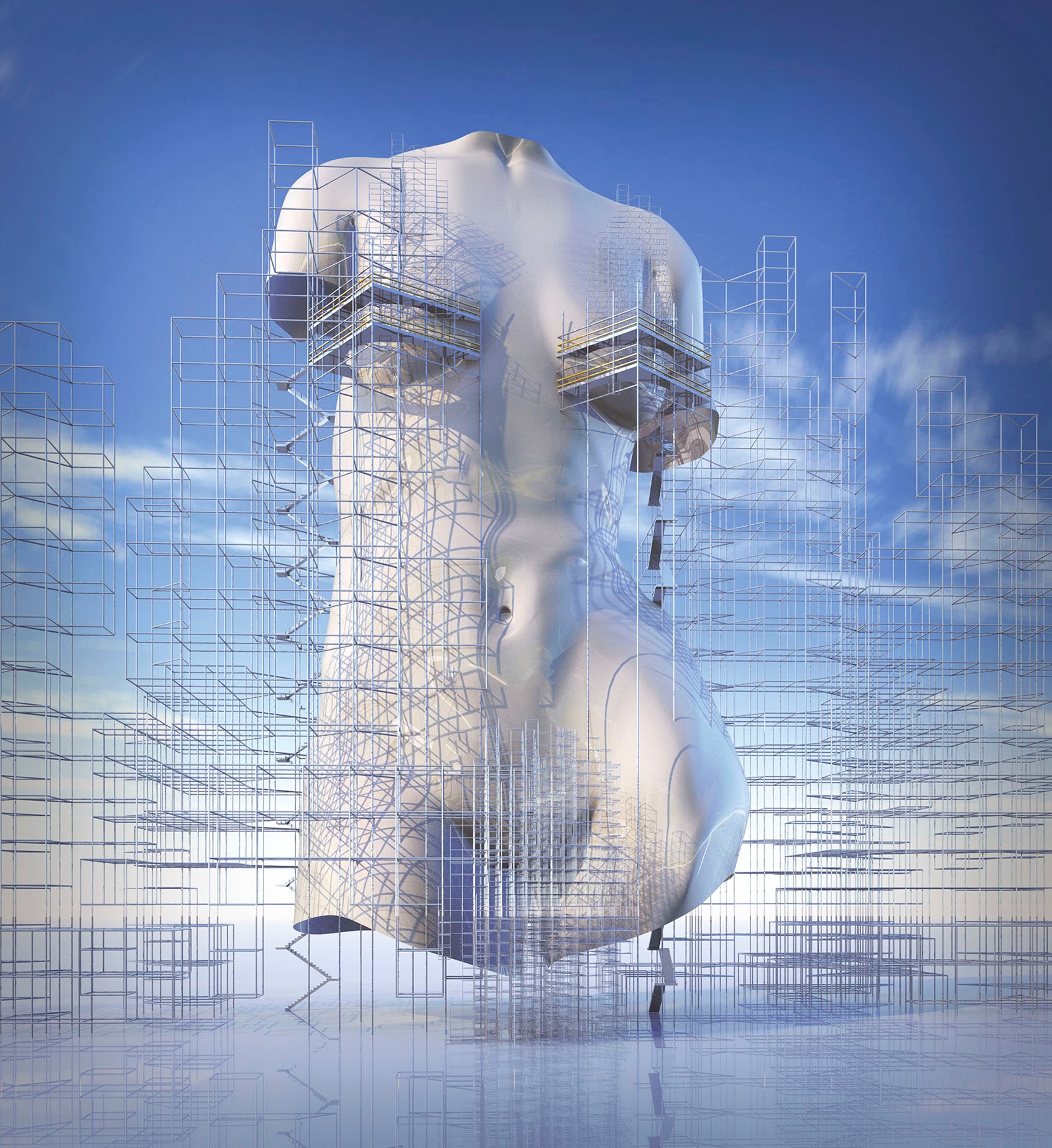
Violet: What I eventually grew to love about 3D is that it’s a bizarro-world combination of photography, sculpture, drawing, and painting. The 3D space is virtual sculpture made of ones and zeros that I take a “photograph” of with the camera in the 3D software. The thing is, I can sidestep many of the limitations that exist in our corporeal world. I don’t have to worry about gravity! Once I realized this and decided to be true to the medium on its own terms, rather than using it to “recreate reality,” as most 3D software was designed to do, cool things started happening.
So, for me, the goal isn’t mimicry or depicting things the way we’re already familiar with. I want to use all the tools baked into the software: modeling capabilities, lighting effects, refraction, to name a few. I want to see what the palette of paints can make, what can be done with it without the constraints of realism. When all these elements are clicking, my work often reads as futuristic or sci-fi, because I’m letting the medium speak for itself.
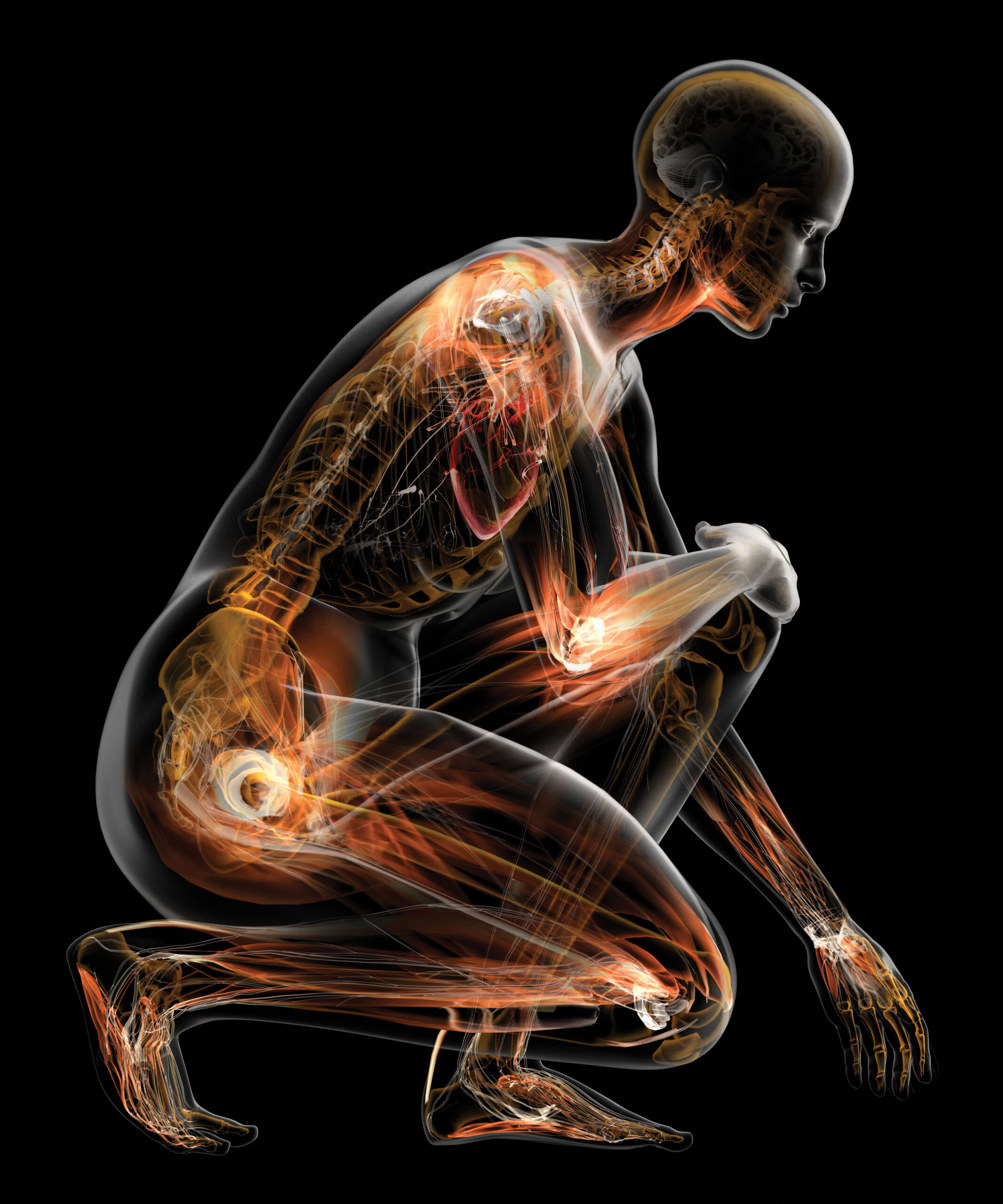
It’s not a question of balancing historical techniques with modern image making, it’s that I love the masters, and I try to learn from them and just use this new set of tools while, for example, keeping Matisse’s forms in mind, keeping Sebastião Salgado’s shades of gray in mind, thinking about Ingres’ economy of line. If 3D is just a new material to make marks with, how would Matisse have used it?
Embodiment and the Artist’s Perspective
You’ve mentioned that the joy of feeling fully embodied since changing genders has deeply connected you to the humility and preciousness of living in our bodies. How has this personal evolution transformed your perspective as a medical illustrator when visualizing the human form for others?
Violet: Oddly, my ideas about the depiction of the body haven’t changed since transitioning. What has changed is my personal relationship to my illustration. Before coming out, all my work was a fantasy of what it felt like to have a body and be alive. Now I can make work that comes from my own experience of being embodied, from having a body that I feel and know is mine.
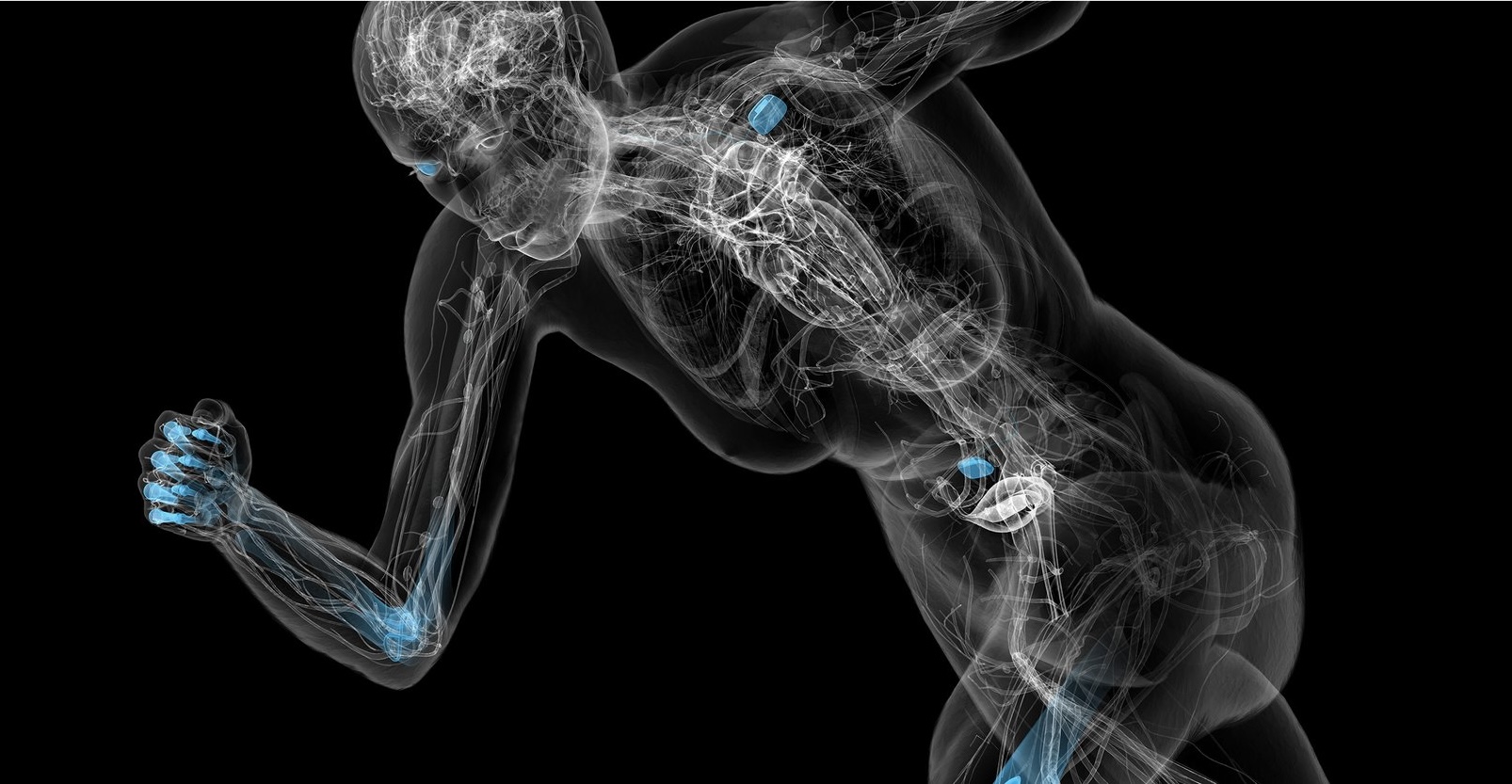
Collaborating with Violet Frances
Can you describe your process? What’s it like to work with you?
Violet: My favorite part of the work is the collaboration.
So. I love the initial calls. I love the early process of discovering what needs to be communicated. I love the conversation and trying to understand what needs to be shown and looking at it from as many angles as possible.
I’ve also had enough experience to know that even if I don’t agree with the art direction I’m getting from a client, that’s merely my opinion. I have had too many examples of following art direction I was skeptical about and it leading to something quite beautiful that wouldn’t have happened if I had been in a bubble doing my own thing.
That said, I also embrace the challenge when I’m given a mass of references and simply told, “Do something with this.”
Ultimately, what I bring to the table is that I’m an artist. And as an artist, I have all of these different interests and backgrounds, and these are the ingredients of what makes the work I do what it is.
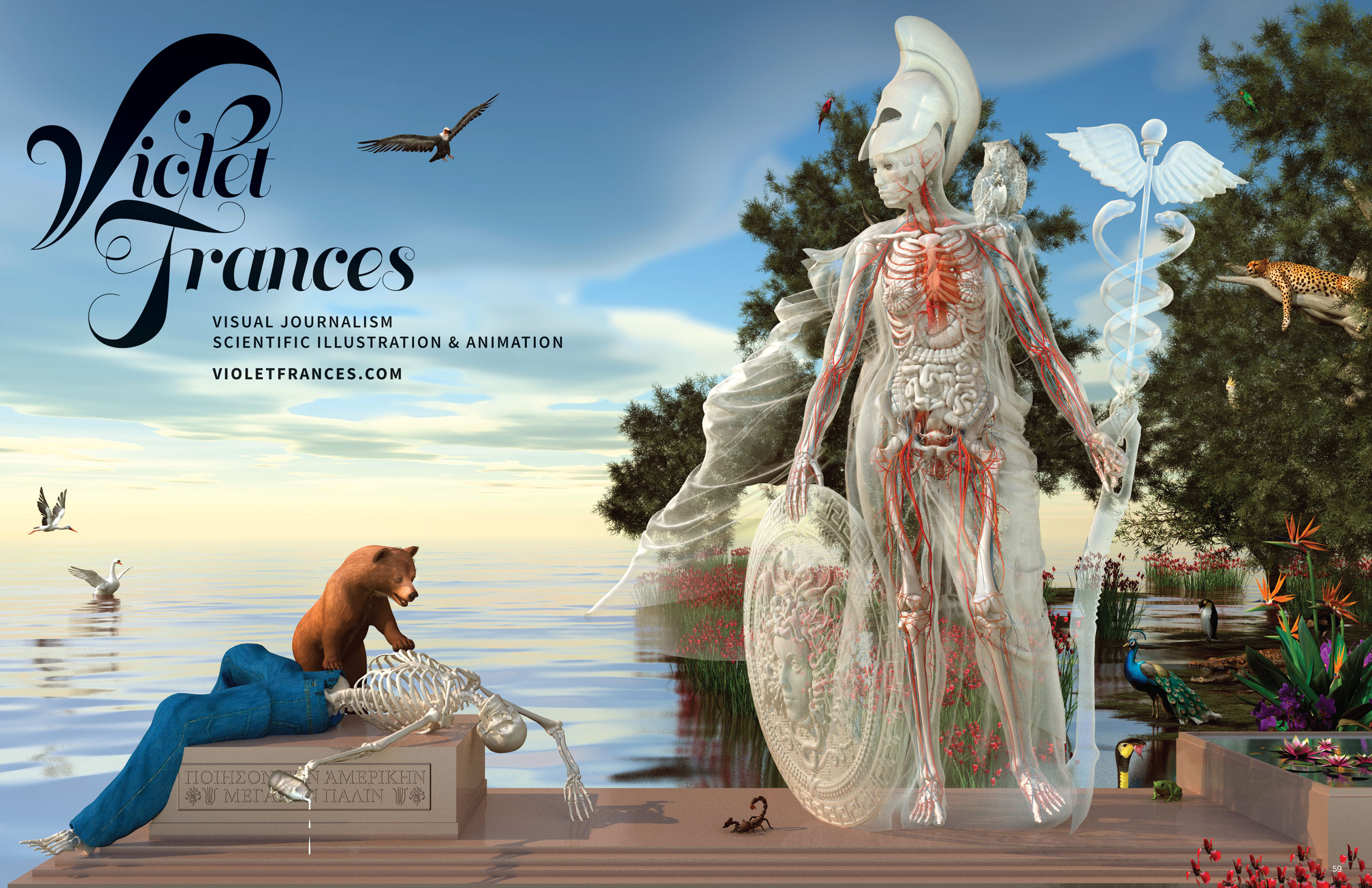
Explore More: To view more of Violet Frances’s medical illustration and animation portfolio, visit her profile on the Medical Illustration & Animation Sourcebook or visit her website. The Medical Illustration & Animation Sourcebook #39 will be distributed in Fall 2026.
ABOUT THE ARTIST
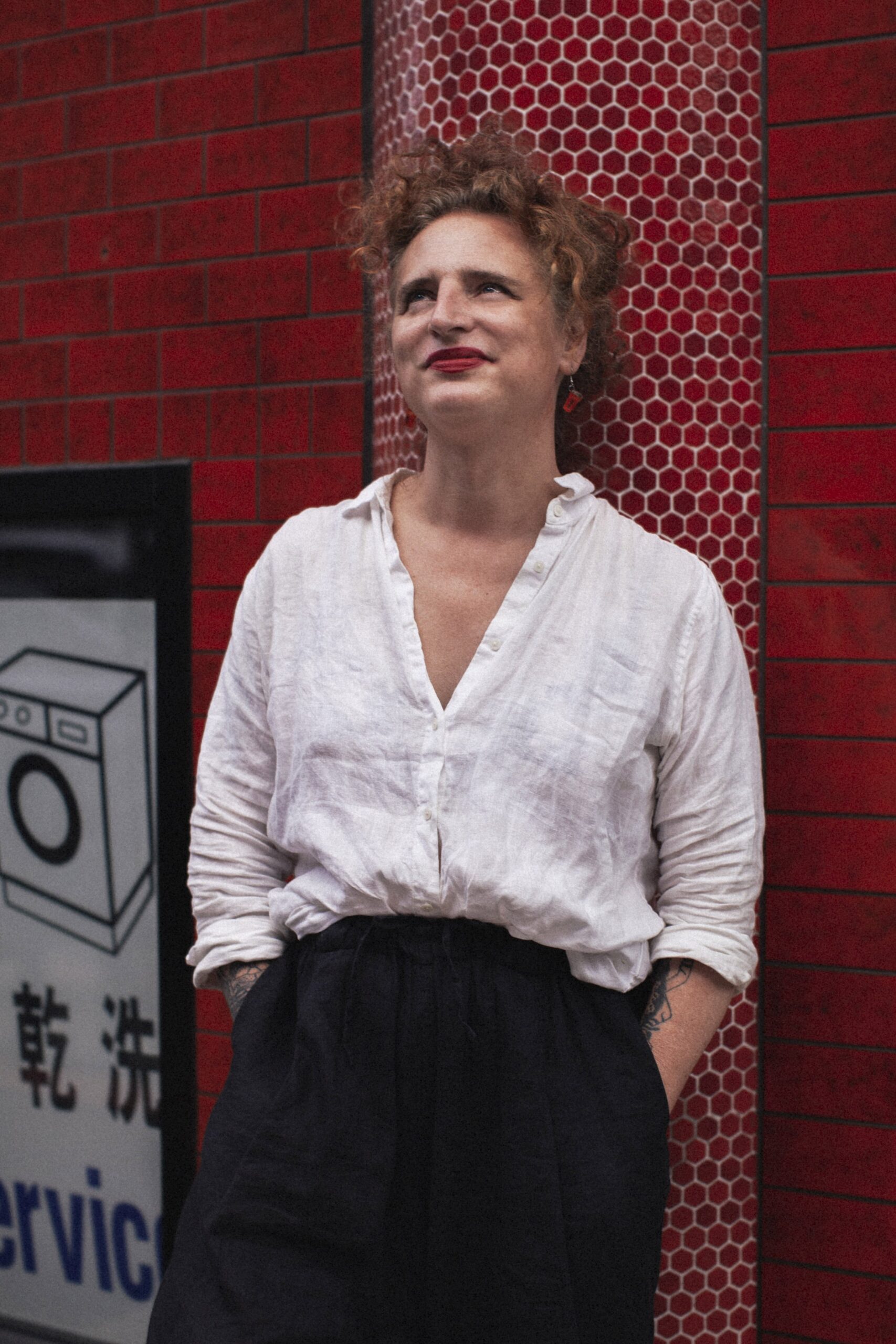
Violet Frances is an award-winning scientific illustrator, animator, and fine artist with 30 years of experience in visual storytelling. Raised in New York City, Violet initially pursued a career as a jazz saxophonist before transitioning into design as an assistant art director at Scientific American. There, she discovered a passion for translating complex scientific concepts—from quantum mechanics to medical biology—into elegant, accessible visual forms. Her career quickly exploded after she began infusing digital 3D illustration with the spirit, lighting, and emotional depth of High Renaissance art, leading to high-profile commissions for publications like WIRED and The New York Times, international speaking engagements, and the expansion of her own studio.
After coming out as a transgender woman, Violet returned to her practice with a renewed aesthetic philosophy centered around embodiment, human connection, and reverence for living bodies. Today, she creates fine art and medical illustrations that bridge science and spirit, illuminating the wonder of biological life for audiences worldwide.